Now is the Time to Reflect on Your Career Trajectory
Get a clear, data-backed career trajectory map for GenAI. Understand shifting roles, choose your path, and plan concrete next steps.

GenAI represents the greatest opportunity for efficiency you may see in your lifetime. As Google's CEO Sundar Pichai has argued, AI is the most profound technology we are working on. It will transform how work gets done and how value is created (Source: CBS 60 Minutes, 2023). In a previous post, I shared my view on the trajectory of this technology. Market pressure will push you to adopt GenAI to reduce costs and gain an edge. If you don't, you risk being left behind. If you're deciding how to build GenAI skills or move into this field, our practical roadmap for aspiring GenAI developers gives you a step-by-step guide to in-demand skills and roles.

In this post, you'll look at the shifts already happening in tech. You'll see where traditional roles are shrinking, and where GenAI-centered roles are growing fast.
Then, you'll explore three main categories of GenAI-related roles. This will help you decide where you fit in this new world of work.
The GenAI Shift Is Underway
The shift is clear. Some teams are shrinking. Others are hiring to capture GenAI-driven efficiency. The transformation is already moving quickly. Here are a few recent examples.
Clear Downsizing Trends

By mid 2024 and into 2025, many companies restructured teams while leaning into AI-driven productivity.
Dropbox cut 16% of its workforce in 2023. CEO Drew Houston cited a strategic shift and the need to focus on AI-powered product roadmaps as a central reason for the changes (Source: Dropbox company blog, Apr 2023).
IBM announced a pause on hiring for roughly 7,800 back-office roles that could be replaced by AI over time. This is one of the earliest large-scale signals that AI is changing workforce composition (Source: Bloomberg, May 2023).
Duolingo reduced reliance on some contract translators after adopting GenAI for parts of its content pipeline. The company confirmed it was rethinking workflows as AI took on more tasks (Source: Rest of World, Jan 2024).
Klarna reported that its AI assistant handled two-thirds of customer service chats, work it said was equivalent to 700 full-time agents. This illustrates real productivity impact inside a large-scale operation (Source: Klarna press release, Feb 2024).
Microsoft announced 1,900 layoffs in its gaming division in January 2024 as part of a broader restructuring, while the company continued to invest heavily in Copilot and AI infrastructure across products (Sources: The Verge, Jan 2024, Microsoft).
Across the sector, tech layoffs persisted in 2023 and 2024. Industry trackers recorded tens of thousands of reductions in 2024 alone, even as companies redirected investment toward AI initiatives (Source: Layoffs.fyi tracker).
Surging AI Job Openings

While some traditional roles are shrinking, AI-centered hiring is rising.
LinkedIn's research shows a rapid rise in job postings mentioning AI skills from 2023 to 2024. Employers are prioritizing candidates who can build with, integrate, or govern GenAI systems at work (Source: LinkedIn Economic Graph, 2024 AI at Work reports).
Indeed Hiring Lab found that job postings mentioning generative AI grew several-fold from 2022 to 2024 in the United States. The demand cuts across engineering, product, operations, and go-to-market roles (Source: Indeed Hiring Lab, 2024).
Lightcast reported a broad surge in demand for AI and machine learning skills across many occupations, not just core engineering roles. The trend accelerated with the release of foundation models and easy-to-use APIs (Source: Lightcast, 2024).
Explosive Growth in AI-Related Roles
Hiring is up across engineering and non-engineering functions.
Roles like LLM Engineer, Prompt Engineer, and AI Product Manager were niche only a short time ago. You now see them on job boards every week. This reflects a rapid shift from research-only to applied GenAI hiring (Sources: LinkedIn Economic Graph 2024, Indeed Hiring Lab 2024).
Postings for software developers that mention GenAI skills are among the fastest-growing subsets of tech job listings in several markets, as teams seek practical builders who can ship AI features quickly (Source: Indeed Hiring Lab, 2024).
New Talent Priorities Are Taking Over
Employers aren't only hiring researchers and PhDs. They want people who can:
Integrate AI into products and workflows.
Manage AI projects, risk, and compliance.
Use GenAI tools to automate creative and analytical tasks.
Multiple analyses show that non-technical roles are also adding GenAI skills at a fast clip. Consulting, marketing, legal, HR, and customer operations all show steep year-over-year gains in postings that reference generative AI (Sources: Indeed Hiring Lab 2024, LinkedIn Economic Graph 2024).
This Is the New Normal
This isn't a short-lived hiring blip. It's a reallocation of tech talent. The practical questions you need to ask now are simple.
Who understands AI enough to lead your transformation.
Who can build real products using GenAI tools.
Who knows how to use AI to solve everyday problems on the job.
If you want to grow your career in tech, AI is no longer optional. It's the foundation you build on. Whether you work in data, development, design, marketing, or product, reskilling has become essential.
Which Path Fits You?
Here's the good news. GenAI opens new opportunities that reward creativity, problem solving, and impact. Based on what I've seen, most AI-related jobs fit into three broad categories. I use these categories to help you make sense of the job landscape as it evolves.
Think of them as paths. Each path matches a different kind of work, mindset, and skillset. Your job is to pick the one that fits how you like to work and what energizes you.
1. People Who Build the Models

These are the folks deep in the math and code. They build the AI itself. They make models smarter, faster, and more accurate. If you're curious about how large language models are fine-tuned across distributed GPUs, or how quantization improves performance, this path may be the right one for you. If you want to understand the technical foundations behind today's most powerful AI systems, read our deep dive into transformer models. It explains self-attention, tokenization, and the architectures behind modern LLMs.
What kind of work would you do?
Train models using large datasets.
Tweak code and algorithms to improve language, vision, or multimodal capabilities.
Solve problems like latency, accuracy, and cost tradeoffs. For example, decide which layers to quantize for the best speed to performance balance.
Focus on architecture, inference speed, loss curves, and tuning.
What kind of person thrives here?
You enjoy hard technical challenges.
You get a thrill from improving systems that are already powerful.
You're comfortable behind the scenes, and you care more about performance than presentation.
You likely enjoy programming, math, or systems engineering.
You might like roles like:
AI Research Scientist
Machine Learning Engineer
Generative AI Engineer
LLMOps or MLOps Engineer
AI Infrastructure Specialist
This path is ideal if you want to shape the core tech that powers AI. It's deeply technical and it changes quickly. If that excites you, it's a great place to be.
2. People Who Use the Models

These people use pre-built models like GPT-4, Claude, Gemini, LLaMA, or image generators like Midjourney, DALL·E, and Stable Diffusion to solve real problems. They don't reinvent the wheel. They use the wheel to build something valuable.
What kind of work would you do?
Build apps or tools that call AI models under the hood.
Connect AI to business needs. For example, create a customer service assistant or an email summarizer for busy teams.
Write and test prompts to get reliable results. If you want to get better here, use our guide to prompt engineering with LLM APIs. You can also learn in-context learning techniques to increase accuracy and control.
Work quickly. Prototype, test, ship.
What kind of person thrives here?
You like making things that work and get used.
You're less focused on how AI works inside, and more interested in what you can build with it.
You're creative, practical, and efficient.
You often think, "How can I solve this with the AI tools I already have."
You might like roles like:
AI Application Developer
Chatbot Creator
Prompt Engineer
GenAI Product Builder
AI-augmented Designer or Content Creator
This path is perfect if you're more of a creator or a hacker than a researcher. You don't need to understand the math to drive the engine and ship value.
3. People Who Organize the Work
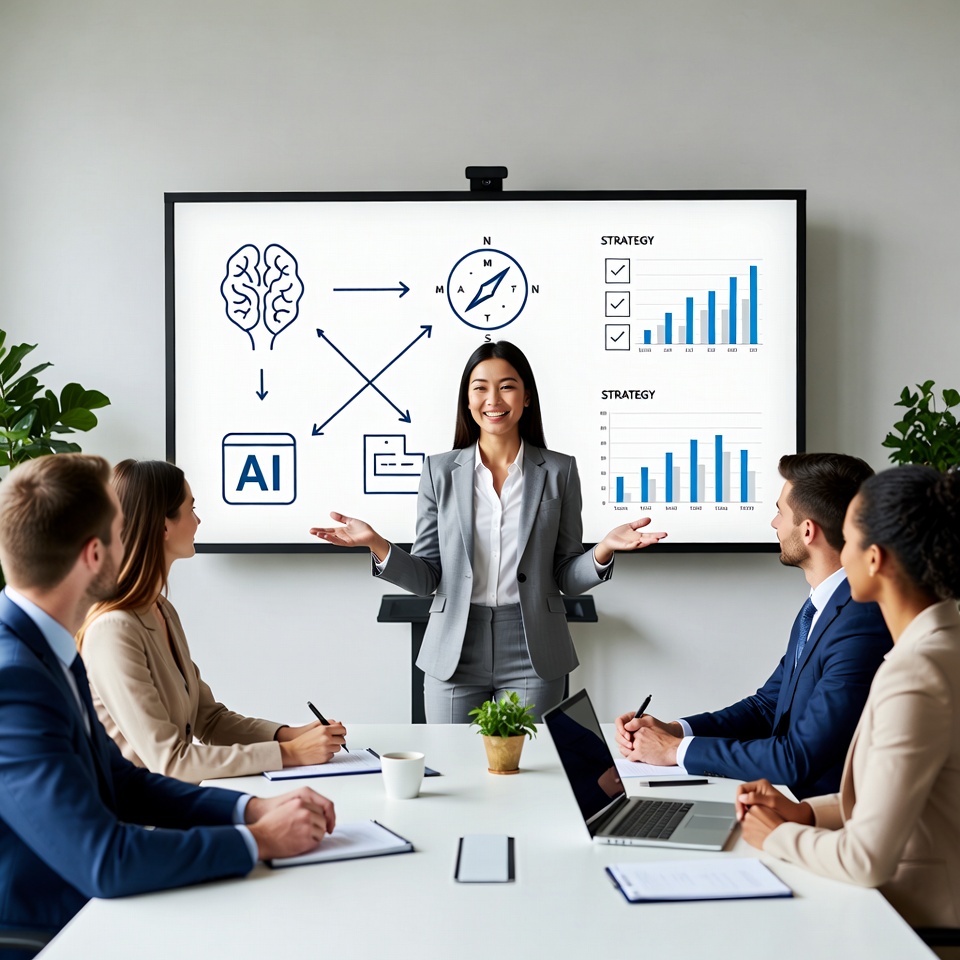
These folks make sure AI work happens, and happens responsibly. They may not build or code every day. They set direction, make decisions, and keep teams aligned.
What kind of work would you do?
Help teams decide where AI fits, and where it doesn't.
Plan projects, set priorities, and track outcomes.
Connect business teams, engineers, and users.
Ensure AI is used safely, ethically, and in line with company goals. If you want a practical starting point, read our guide to implementing reinforcement learning from human feedback. It covers safeguards and ethics for AI projects.
What kind of person thrives here?
You're a natural communicator or planner.
You like bringing people together to deliver results.
You see the big picture and balance risk and opportunity.
You're curious about AI, even if you don't want to write the code.
You might like roles like:
AI Product Manager
GenAI Program Lead
AI Solutions Architect
AI Ethics and Compliance Officer
GenAI Strategy Consultant
This path is for you if you want to lead, organize, and make sure AI delivers value. It's about people and process, as much as it's about technology.
Wrapping Up
It's hard to argue with the evidence now. GenAI is already reshaping technology work. It's changing how you work, and it's changing the work itself. You've watched teams restructure and hiring strategies pivot toward AI. The moment is exciting. There's more than one way to thrive. Some of you will build the systems. Some will use them to create value. Others will organize the work. All three paths matter. If you want to see how these paths intersect in practice, our practical lessons from building multi-agent systems show how collaborative GenAI workflows are shaping the future of work.
The only thing that doesn't make sense anymore is standing still.
A word of caution. The most dangerous mindset is believing you already have the skills to succeed in this new world. You likely don't. If you try to apply old paradigms to AI projects, you'll create fragile solutions and predictable failures. Development patterns that once worked may now miss the point completely. If you have years of experience, plan for significant retraining.
Knowing which path fits you helps you prioritize the right projects, learning plan, and resources. Your direction can evolve. Clarity gives you a practical blueprint. You'll know what tools to learn, which projects to build, and which skills to go deep on. That clarity is what sets you up for success in the fast-moving GenAI era.
Sources for verification.
CBS 60 Minutes. "Google CEO Sundar Pichai on the future of AI." Apr 2023. https://www.cbsnews.com/news/google-ceo-sundar-pichai-artificial-intelligence-60-minutes-transcript/
Dropbox company blog. "Update from Drew: Our next chapter." Apr 27, 2023. https://dropboxblog.com/topics/company/update-from-drew-our-next-chapter
Bloomberg. "IBM to Pause Hiring for Roles That AI Could Replace." May 1, 2023. https://www.bloomberg.com/news/articles/2023-05-01/ibm-to-pause-hiring-for-back-office-roles-that-ai-could-replace
Rest of World. "Duolingo scales back human translators as AI takes over some tasks." Jan 2024. https://restofworld.org
Klarna press release. "Klarna's AI assistant handles two-thirds of customer service chats, equivalent to 700 agents." Feb 28, 2024. https://www.klarna.com/international/press
The Verge. "Microsoft lays off 1,900 employees in its gaming division." Jan 25, 2024. https://www.theverge.com/2024/1/25/24049143/microsoft-xbox-activision-blizzard-layoffs
Layoffs.fyi. Tech Layoff Tracker. https://layoffs.fyi
LinkedIn Economic Graph. "AI at Work" research series, 2024. https://www.linkedin.com/business/insights
Indeed Hiring Lab. "Generative AI and the labor market." 2024. https://www.hiringlab.org
Lightcast. "The AI Skills Boom." 2024. https://lightcast.io