AI Agents: The Core Design Patterns Every Leader Should Understand
Learn how AI agents actually work under the hood and when to use each one, and how to choose the right architecture for your goals.

By now, it's pretty clear that AI agents are opening up new ways to automate the kind of knowledge work that used to require human thinking. In my previous post about AI agents, I talked about how this shift is changing the way we build applications to solve complex problems. But here's the thing. With all these terms floating around (AI Agents, Agentic AI, Multi-Agent Systems), it's really easy to get lost in the jargon and miss what actually matters: the core design principles that make these systems work.
Let me be clear about something. AI agents aren't some new type of AI model. They're actually a set of clever design patterns that use existing LLMs and reasoning models in a fresh way. By adding reasoning, planning, and tool execution into the mix, they can tackle much more complex tasks with better quality and less code. These systems range from single agents working independently to multi-agent frameworks where several agents collaborate toward a shared goal. And there are plenty of approaches in between. If you want to design effective AI-driven solutions, you really need to understand the nuances of these different architectures.

In this post, I'll break down the major AI agent design patterns and clarify when to use each one. My goal is to help you figure out which approach best fits what you're trying to build. Whether you're working on a standalone agent or orchestrating a multi-agent system, understanding the trade-offs will help you make better design decisions. And if you're looking for practical, step-by-step guidance on launching agent-based projects, our roadmap to successful AI agent projects gives you actionable advice on defining metrics, aligning teams, and iterating for real-world results.
Single AI Agent Architectures
Single-agent architectures rely on one language model to handle reasoning, planning, and tool execution all by itself. The agent operates based on a system prompt and has access to predefined tools. But instead of following a fixed sequence, it selects the best course of action dynamically. As I mentioned in my last post on AI Agents, this approach means you don't have to manually define every possible workflow. The LLM intelligently figures out what steps and tools it needs to achieve an objective.
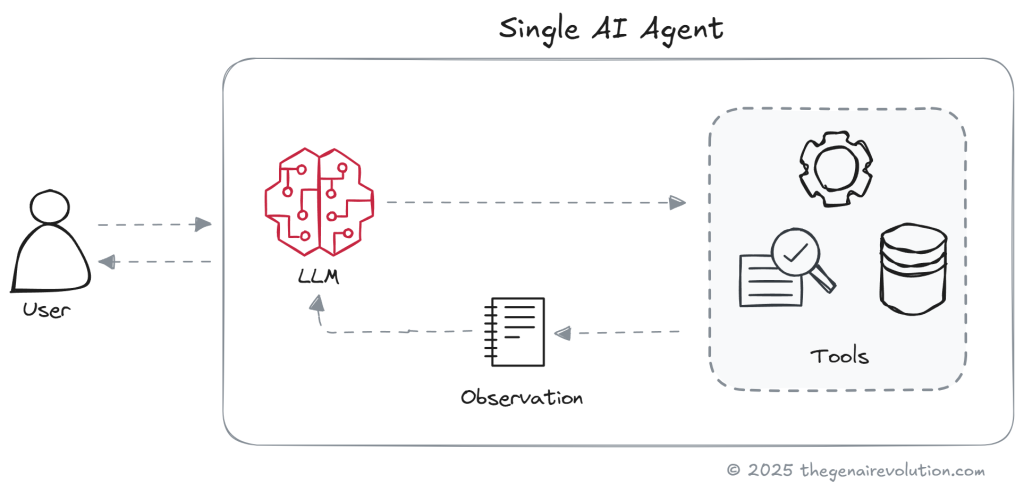
Key characteristics
The task only needs one role to handle reasoning and decision-making
The workflow adapts to the situation instead of following a rigid process
The agent picks and uses tools autonomously, not following predefined logic
The use case is structured enough for a single agent to solve on its own
The agent works without external collaboration or feedback from other agents
Challenges
Limited scalability: Single agents have a hard time with complex workflows that need multiple roles or collaboration
No peer validation: Without other agents to provide feedback, mistakes might go unnoticed
Execution loops: Without strong self-correction mechanisms, agents can get stuck doing the same thing over and over
Complex reasoning and memory issues: Without advanced memory mechanisms, single agents struggle with multi-step tasks that require reflection or extended context
Key Research on Single-Agent Systems
ReACT: A framework that enables adaptive decision-making by combining reasoning, acting, and observation in a continuous cycle. (Paper)
RAISE: An extension of ReACT that improves self-correction and long-term memory retention through introspection and self-evaluation. (Paper)
Reflexion: A method that gives language agents self-reflective feedback, leading to better reasoning and fewer hallucinations. (Paper)
LATS: Language Agent Tree Search unifies reasoning, acting, and planning in language models by integrating Monte Carlo Tree Search. This enables more deliberate and adaptive problem-solving. (Paper)
Multi-Agent AI Architectures
Multi-agent architectures involve two or more AI agents working together to solve a problem. Unlike single-agent architectures where one language model handles everything independently, multi-agent systems distribute tasks across different agents. Each agent has specialized roles and responsibilities. This collaborative approach really shines in scenarios that need diverse skills, complex workflows, or peer validation. When people talk about Agentic AI, they're usually referring to multi-agent systems.
Multi-agent architectures exist on a spectrum. Sequential and hierarchical structures represent two key approaches, but there are many hybrid variations that blend aspects of both to suit different needs and complexities.
Sequential Agents
When you have a predetermined process that doesn't require reasoning, sequential agent architecture makes sense. In this setup, two or more AI agents are sequenced together. Each agent completes its task and passes the output to the next agent. While you can have routing decisions, they're mechanical and don't require actual reasoning.
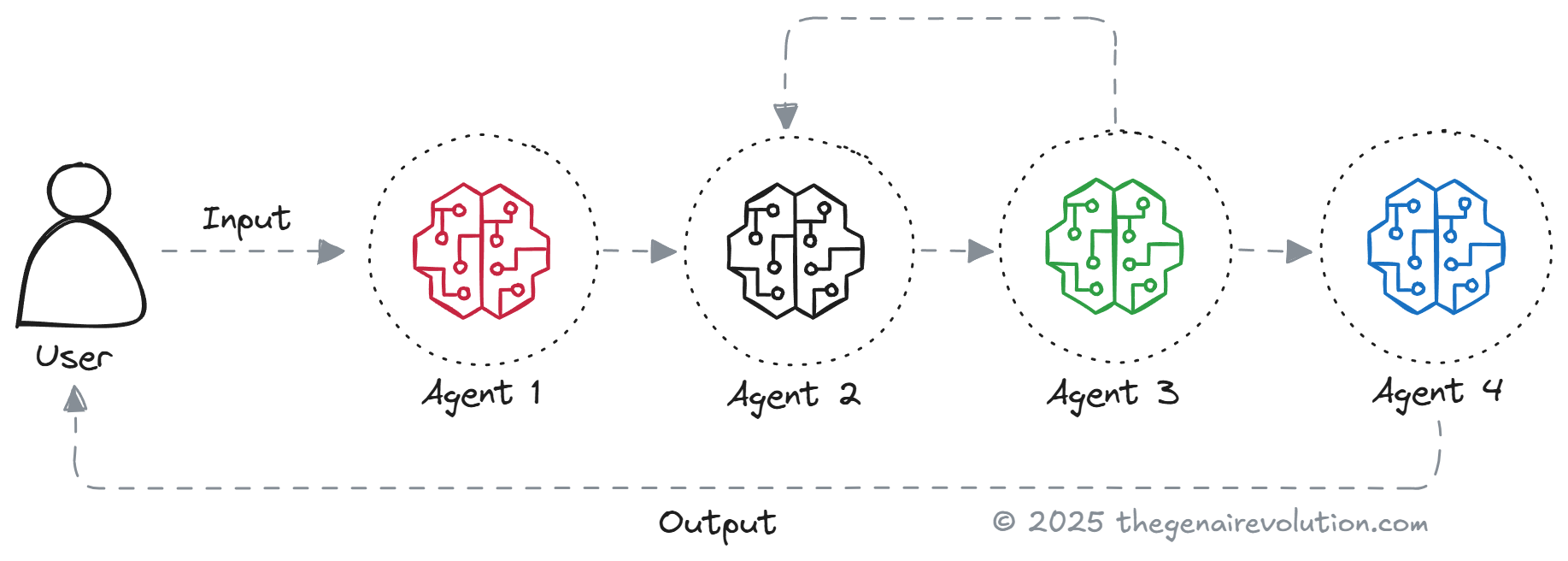
The main thing about this architecture is that there's no central coordinating authority (unlike hierarchical agents). Each agent independently does its job and forwards its output to the next agent. Also, keep in mind that the process can be circular rather than strictly linear. An agent might send data back to a previous step if necessary.
Hierarchical Agents
Hierarchical agents come into play when processes can vary and you need to handle many different situations. In this setup, a central AI agent oversees everything. It calls different agents based on what's happening. The central agent makes decisions based on what the subordinate agents produce and figures out what to do next.
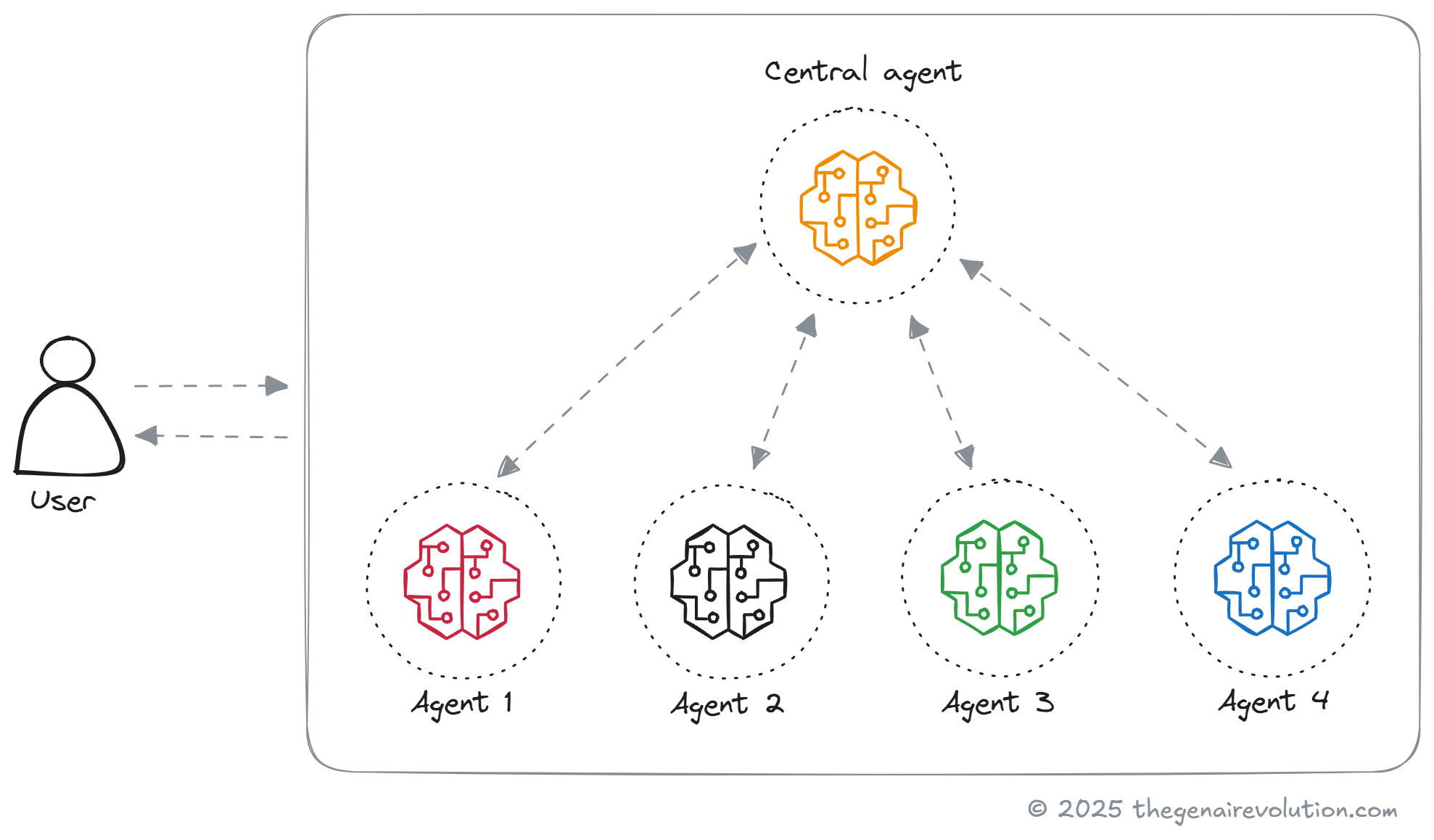
The key characteristic here is that all interactions ultimately return to the central AI agent. This keeps decision-making streamlined.
Key Characteristics
Multiple roles required: Agents specialize in different functions to efficiently handle complex workflows
Adaptive workflow: Agents dynamically coordinate and adjust based on task requirements instead of following a rigid sequence
Autonomous tool selection: Agents pick and use tools on their own, leveraging communication with other agents to refine their actions
Parallel execution support: The system lets multiple agents work simultaneously on different subtasks for faster problem-solving
Shared knowledge: Agents exchange insights and feedback to improve accuracy and ensure a cohesive approach
Challenges
Coordination Complexity: Getting agents to communicate efficiently and divide tasks properly requires robust frameworks
Resource Intensity: Multi-agent setups generally need more computational resources and use more tokens than single-agent models
Information Overload: Agents have to filter relevant information to avoid unnecessary chatter and inefficiencies
Dependence on Agent Roles: The system only works well if agent personas and tool access are well-defined
Key Research on Multi-Agent Systems
MetaGPT: A framework that improves collaboration among multiple agents by structuring their outputs (like documents and diagrams) to reduce redundant communication and make teamwork more efficient. (Paper)
AgentVerse: A multi-agent coordination model that follows four key phases: recruitment, decision-making, execution, and evaluation. This organizes agent collaboration and helps study emergent behaviors. (Paper)
Embodied LLM Agents Learn to Cooperate in Organized Teams: A study on leadership in multi-agent systems. It shows that teams with a designated leader coordinate more effectively and get better results. (Paper)
DyLAN: A dynamic agent network that enhances reasoning and code generation by continuously ranking and adjusting agents' contributions based on their past performance. (Paper)
How Leaders Can Apply This
So you're trying to decide whether to start with a single agent or build a multi-agent framework. Use this section as your guide. It gives you clear questions and steps to help you choose the architecture that serves your strategy, risk profile, and cost constraints. For a broader perspective on managing GenAI tool adoption within technical teams, check out our guide on managing GenAI tooling adoption for technical teams.
Decision Framework
Decision Area | Questions to Ask | What to Look for in Answers |
|---|---|---|
Task Complexity | Is the task linear or does it need specialized roles or reasoning? | Repetitive tasks suit single agent. Complex workflows or multiple competencies point toward multi-agent. |
Adaptability | Will the process need to change over time or handle unexpected inputs? | If yes, hierarchical or hybrid multi-agent helps. If no, sequential or single agent may suffice. |
Cost & Resource Constraints | Can you tolerate higher compute costs or more latency? | Single agent is cheaper to start, multi-agent costs more but scales for bigger problems. |
Governance & Error Handling | Do you need peer validation or oversight for compliance or safety? | Multi-agent gives built-in reviews. Single agent needs strong fallback mechanisms. |
Latency & Parallelism | Is fast response required, or can you afford sequential steps? | Multi-agent allows parallel work. Single agent or sequential agents work if time is less critical. |
Metrics to Monitor
Accuracy or error rate in outputs, especially where self-correction or peer feedback exists
Latency or wall-clock time from user request to solution delivery
Token usage, compute cost, and operational cost over time
System stability: rate of failures, loops, or unexpected behavior
Maintainability: how costly it is to add new roles or tools
If you're interested in measuring the business impact of your AI agent initiatives, our article on measuring the ROI of AI in business provides frameworks and case studies to help you assess value and outcomes.
When to Use Each Design Pattern
Use a single agent when tasks are well-defined and simple, or if cost and speed matter more than specialization
Use sequential multi-agent when you have a fixed pipeline of steps that don't need much dynamic routing or change
Use hierarchical or hybrid multi-agent when tasks vary, inputs are unpredictable, when you value checks and balances, or want parallel execution
Leadership Actions
Map your workflows: Take your current and planned workflows and classify them by complexity, adaptability, and risk. Use the decision framework to put each potential use case in the right bucket.
Challenge your technical team: Get them to discuss design trade-offs. Ask them to prototype both single-agent and multi-agent versions. Compare cost, performance, and failure modes.
Set up metrics early: Track latency, cost, and error recovery. Use those numbers to decide whether to scale with more agents or simplify.
Review governance paths: Make sure oversight exists if agents can affect critical decisions or business risk. Assign responsibility for monitoring agent behavior.
Conclusion
Agents are powerful because they automate complex knowledge work. They mimic how humans think, reason, and refine their decisions. Think about it. When you tackle a complex task, you don't just go with your first thought. You explore options, do research, draft something, get feedback, and refine until you reach the best outcome. Agents follow that same process, whether they're working independently or coordinating with others.
The AI agent architectures we've explored in this post unlock new possibilities. They enable use cases that were previously impossible. By structuring reasoning, adapting to new information, and iterating on solutions, they consistently enhance quality. If you want the best results, embrace agent-based designs. They dramatically improve output quality and push the boundaries of what you can achieve.